Replacing a roof in New Jersey is one of those projects you feel in your budget and in your bones. The numbers are real, the decisions stick for decades, and the calendar matters because weather is not an afterthought here. I have managed roof projects in Morris County in March sleet and in Cape May in July humidity, and the lesson is the same: the price of a new roof is more than shingles per square. It is labor logistics, material choices, municipal permits, disposal, ventilation, and the what-ifs you hope not to meet once the old layers come off.
This guide breaks down the moving parts behind a typical NJ roof replacement, what drives the price up or down, and how to read estimates so you pay for craftsmanship, not confusion. If you are searching Roof replacement or Roofing contractor near me, you want a clear sense of what a fair number looks like and what questions separate a solid bid from a gamble.
What a “typical” NJ roof costs
For a standard single-family home in New Jersey with a 1,800 to 2,400 square foot roof area, most asphalt shingle replacements land between 9,000 and 18,000 dollars in 2026 dollars, assuming one existing layer, standard slope, and basic flashing. That spread widens with steeper roofs, multiple stories, skylights, complex valleys, or premium materials like metal or slate. Some real-world anchors from recent projects:
- A 1,900 square foot ranch in Ocean County, moderate pitch, one layer tear-off, architectural shingles, ridge vent, new flashings: 12,800 dollars total. A 2,600 square foot colonial in Somerset County, steeper pitch, two layers removed, five box vents converted to continuous ridge, ice barrier upgraded at eaves and valleys: 17,900 dollars. A 1,400 square foot Cape in Bergen County, dormers, multiple valleys, two skylights replaced, chimney repointing and new lead flashing: 16,200 dollars.
You can find lower bids, often by reducing tear-off scope, cutting underlayment quality, skipping ice-and-water coverage beyond code minimums, or using off-brand shingles. Expect higher bids if decking replacement is extensive or if you select metal, cedar, or synthetic slate, where the labor and materials jump at least 2 to 4 times compared with asphalt.
How the square system works and why it matters
Roofers price by the square. One square equals 100 square feet of roof surface. Materials, underlayment, and disposal scale with squares, not the house’s interior square footage. A 2,000 square foot ranch can have a 2,200 to 2,600 square foot roof depending on overhangs and pitch, while a 2,000 square foot colonial with dormers and valleys might push 3,000 roof square feet. Pitch is the sleeper variable. A 5/12 pitch is common and walkable. An 8/12 bumps labor and safety gear because footing is limited. A 10/12 or higher means harnesses, roof jacks, and more time per square. The same material on a steep roof takes more man-hours and can add 15 to 35 percent to labor.
When you ask for the Price of new roof, confirm the contractor measured the roof or used aerial/DRONE/LiDAR reports. A one-square miscount is small on paper but can be 500 to 1,200 dollars difference depending on shingle type, underlayment, and disposal. I have seen driveway estimates off by five squares because no one crawled the back addition. Measure twice, buy once is a cliché that still pays.
Labor: the biggest line item you do not see
In New Jersey, labor often accounts for 50 to 60 percent of an asphalt shingle replacement. On a 14,000 dollar job, 7,000 to 8,500 is the crew’s time. Why so much? Speed without shortcuts takes coordination: delivery timing, tear-off crew, installers, metalwork for flashings, ventilation adjustments, and cleanup. A pro crew of five to eight can replace a 20 to 30 square roof in one to two days if the decking is sound. Add days for steep roofs, multiple stories, complex flashing, and wood replacement.
Labor rates reflect more than wages. Payroll taxes, workers’ comp, general liability insurance, safety equipment, vehicle and dumpster costs, and supervision hours add up. In New Jersey, workers’ comp for roofing is costly because it is a high-risk trade. If a bid looks too lean, ask to see proof of insurance. Hiring an uninsured crew puts you on the hook if someone falls. That bargain can become the most expensive mistake on your property.
A meaningful difference shows up between installers who staple felt and those who detail underlayment like a water management system. Valleys, penetrations, and transitions take finesse. A carefully cut shingle around a pipe boot, a woven or closed-cut valley laid over ice barrier, a chimney step flashing set in a clean reglet cut and counterflashed with lead or stainless, all of that is time and experience. The cost is in the hands, not the marketing.
Materials: what you pay for, what lasts, and where to splurge
Asphalt shingles dominate New Jersey because they are cost-effective and perform well through freeze-thaw cycles, salt air near the Shore, and summer heat. Within asphalt, you have choices:
- 3-tab shingles: Cheaper, flatter look, lighter weight, shorter lifespan, usually 15 to 20 years in our climate. Less common now. Savings on day one can disappear by year 12 if wind-driven rain shortens service life. Architectural or dimensional shingles: Heavier mat, layered look, better wind rating, 25 to 35 years with proper ventilation and installation. Most homeowners choose this tier. Manufacturer lines like GAF Timberline HDZ, CertainTeed Landmark, or Owens Corning Duration are typical. Designer asphalt: Thicker profiles that mimic slate or shake without the weight. They add cost and require careful detailing at hips and ridges.
Metal, cedar, synthetic slate, and true slate exist across the state, especially on historic homes in Montclair or Princeton and coastal builds in Long Beach Island where salt and wind favor metal. Metal roofs can last 40 to 70 years but expect 700 to 1,400 dollars per square in materials alone, plus higher labor. Cedar needs ventilation and right-side-up nailing to avoid splitting. Slate, whether natural or synthetic, calls for specialized crews and often structural review.
Underlayment choices matter almost as much as the shingle. A high-quality synthetic underlayment resists tearing and wrinkling, keeps the deck dry during installation, and protects if shingles lift in a storm. Ice and water shield is nonnegotiable in New Jersey. Most towns require it from the eaves to at least 24 inches inside the warm wall line, plus valleys and around penetrations. I recommend ice barrier at all eaves, valleys, skylight perimeters, and sidewall transitions even if local code allows less. Materials add a few hundred dollars on a typical roof and avert leaks that can wipe out drywall and insulation.
Flashing metals typically include aluminum, galvanized steel, or copper. Aluminum is common and fine when painted and installed right, but it does not like direct contact with masonry long term. Chimneys with mortar joints do best with lead or copper counterflashing. The price delta is real, yet the failure cost is higher when water finds a lazy path behind aluminum against brick.
Ventilation hardware is the last materials bucket homeowners overlook. Ridge vent paired with balanced soffit intake keeps shingle temperatures lower and attic humidity in check. Many New Jersey homes built before the 1990s rely on gable vents or a handful of box vents that are insufficient for today’s tighter envelopes. Converting to a continuous ridge vent and opening soffit intake slots can add a day of carpentry and 20 to 30 vents worth of free airflow. The shingle warranty and roof lifespan benefit directly.
Tear-off, decking repair, and disposal
Most New Jersey municipalities and manufacturers require complete tear-off rather than layovers. Removing shingles exposes the deck, lets crews fix soft spots, and brings the roof into compliance with modern underlayment and ventilation. A tear-off for a 20 to 30 square roof runs 1,000 to 2,200 dollars in labor plus dumpster and disposal fees. Landfills charge by weight. Two layers weigh roughly double and can tack on 800 to 1,500 dollars between extra labor and a second dumpster pull.
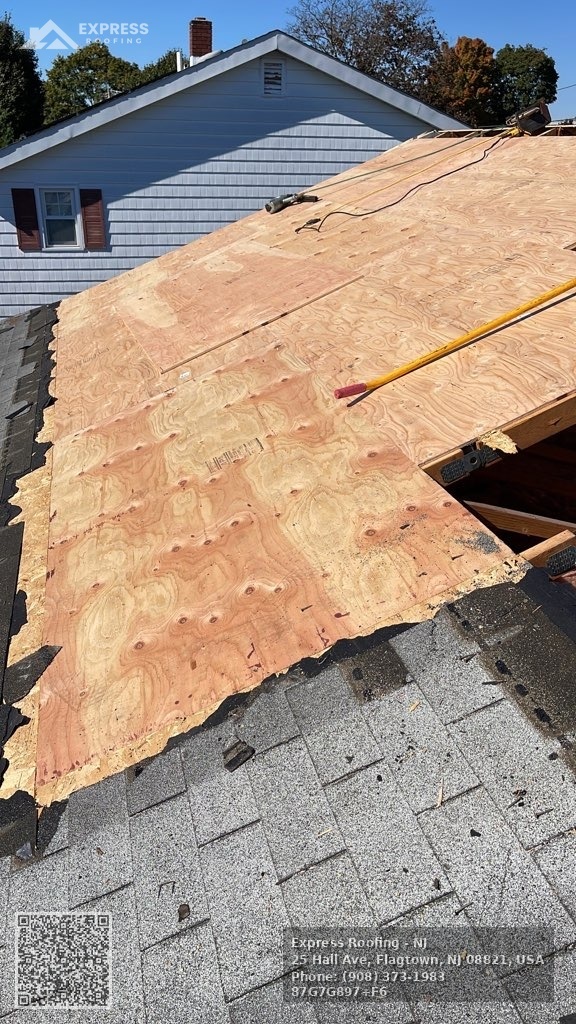
Decking replacement is a variable. Many homes have 1x roof boards or plywood. Sagging, rot around chimneys and skylights, and soft spots at eaves happen. Budget for 2 to 6 sheets of plywood as a contingency. In 2026, 1/2 inch CDX or OSB sheets run 30 to 45 dollars at retail, more once delivered and installed. On a colonial in Union County we replaced 14 sheets after finding chronic ice dam damage, an unplanned 900 to 1,200 dollars that saved the new roof from spanning mush. A good estimate will list a per-sheet price for unexpected decking replacement. That transparency avoids on-the-day surprise markups.
Permits and inspections in New Jersey
Roof permits in New Jersey are handled at the municipal level under the Uniform Construction Code. Many towns require a permit for any roof replacement involving a tear-off. A few allow direct replacement of a single layer of shingles over existing without a permit, but that is less common and less advisable. Permit fees typically range from 50 to 200 dollars for residential re-roofing. Expect higher if your town adds a plan review fee or if the job includes structural changes, skylight framing, or major sheathing replacement.
Inspections vary by municipality. Some require an in-progress inspection after tear-off to confirm decking condition and underlayment, then a final inspection for code compliance. Others only require final. If your Roofing contractor near me says no permit is needed, verify with your local Building Department. I have seen insurance claims denied after storm damage because the previous roof lacked a permit and had improper ice barrier coverage. The thirty-minute errand to the counter is worth it.
In coastal A and V flood zones, there can be wind uplift requirements or fastener schedules beyond standard. Towns in Cape May, Atlantic, and Ocean counties sometimes adopt stricter fastening patterns. Inland towns may follow standard code. Either way, a contractor who works across counties should know these differences and build them into both the estimate and the install.
Seasonal timing and weather windows
New Jersey roofs go on year-round when weather allows, but shoulder seasons work best. Spring and fall offer moderate temperatures that let shingles seal properly and crews move safely. Winter installations are possible, with adjustments. Manufacturers set a minimum temperature for optimal self-sealing. In January, expect hand-sealing in critical areas and more caution around brittle shingles, plus more days lost to snow or ice. Summer brings fast seal times but also heat stress for crews and softened asphalt that scuffs if walked too soon.
Lead times swing with storms. After a widespread wind event, schedules fill for weeks. If you are planning a discretionary Roof replacement, schedule before hurricane season peaks or after the first frost. Emergency Roof repair can happen any time, but full replacements get queued. Good Roofing companies in New Jersey will tarp and stabilize leaks quickly, then circle back for complete replacement after permits and materials are in hand.
What a complete estimate should include
A thorough estimate reads like a small scope-of-work document. Anything ambiguous in writing becomes an argument on the roof. Here is what belongs on the page:
- Measured roof size in squares, with pitch noted and a diagram or aerial report reference. Materials by brand and line: shingle type and color, underlayment type, ice and water coverage locations, ridge vent product, starter and hip/ridge caps, and flashing metals. Tear-off details: number of layers to remove, dumpster provision, and property protection plan for landscaping and siding. Decking policy: included replacement amount or per-sheet rate for damaged sheathing. Penetrations and features: pipe boots, skylights, satellite dish handling, attic fans, solar mounts if present, and chimney flashing approach. Ventilation plan: how intake and exhaust will be balanced, whether soffits will be opened, and what old vents will be removed and patched. Permits and inspections: who pulls the permit, expected fees, and inspection stages. Warranty terms: manufacturer warranty registration and the contractor’s workmanship warranty length and what it covers.
If you do not see those items, ask. A two-sentence bid with a lump sum invites assumptions that rarely favor the homeowner.
Why some bids are lower and what gets cut
When I review competitive bids for clients, the low numbers usually cut in predictable places. The first is ice and water shield, limited to the minimum, and sometimes not used in valleys. The second is ventilation, leaving existing box vents in place while adding a ridge vent, which short-circuits airflow instead of balancing it. The third is flashing reuse, especially at chimneys and sidewalls. Pulling and replacing step flashing properly takes time and skill, and it lives under the siding. Reuse saves hours but leaves the oldest metal in the most leak-prone spot. The fourth is crew size. A skeleton crew stretches a one-day tear-off into three. That increases exposure to weather and homeowner disruption.
Then there are materials swapped for off-brand equivalents. Every brand has good and better lines. I do not insist on one manufacturer, but I insist the system components match their certified paths if a warranty matters. A patchwork of leftover caps, mismatched starter strips, and bargain-bin underlayment might save 300 dollars and cost years of service life.
The hidden costs you should bring into the open
Disposal overage charges can sneak into a final bill if the dumpster fills early. Clarify if the price includes one dumpster pull or enough to cover expected weight and layers. Protecting the driveway with sheets of plywood under the dumpster wheels and a magnet sweep at the end should be standard, not an upsell.
Skylight replacements are wise to do with the roof. A standing skylight past 20 years is a liability on a new roof because the new flashing will outlive the old frame and seals. A Velux replacement adds 1,200 to 2,500 dollars per unit installed depending on size and whether interior trim must be redone. Cheaper to do now than tear into a finished roof in three years.
Gutters and leaders may need to come off for drip edge and ice barrier at the eaves. Rehanging can be included or not. If your gutters are pulling, dented, or undersized for steep roof planes, this is the moment to upgrade. Adding larger 6-inch K-style with 3x4 leaders in heavy tree zones helps keep water away from foundations.
Navigating insurance and storm claims
After wind or hail, insurance may cover repair or replacement. The adjuster’s scope often lists line items at standardized pricing that do not reflect your roofing market’s labor conditions. A seasoned contractor will supplement with photos and code references to include ice barrier, drip edge, ridge vent conversion if needed, and proper flashing. Do not fix small sections with shingles that no longer match. In New Jersey, some policies include matching coverage. Document everything. A Roof repairman near me who understands Xactimate and local code can keep you from accepting a half measure that fails resale.
If the damage is limited to a slope or two, you may be tempted to patch. I weigh the age of the roof, shingle availability, and granule loss. A 10-year-old architectural roof with isolated wind lift can be repaired. A 18-year-old system that has lost UV granules turns every patch into a billboard. The repair looks new, the field looks tired, and the next nor’easter finishes the job. Spending 1,800 twice over two winters on repairs to avoid a 12,000 replacement is not savings.
Choosing a contractor in New Jersey without losing weeks
You can call five companies and hear five stories. Here is a streamlined way to land on a strong fit without analysis paralysis:
- Look for a local office and a track record in your county. Roofing companies in New Jersey know their inspectors, their wind zones, and which neighborhoods hide two layers under algae. Out-of-state plates after a storm are a red flag. Ask who is on the roof. Some firms rely solely on subcontractor crews. That can work well if the same crews work for them daily and your contract is with a company that stands behind workmanship. What you want to avoid is a bid machine that sells the job and hands it off to the lowest installer that week. Request references from jobs older than three years. Fresh roofs do not leak. You want to know how the system aged through two winters. Verify insurance. Ask for certificates with your name and address as certificate holder. Confirm workers’ comp and general liability are active. Compare scope apples to apples. If one bid lacks drip edge, ice barrier in valleys, or new step flashing, note it. It is not a bargain if it skips steps.
If you want to shorten the list, search Roofing contractor near me and filter by reviews that mention cleanup, deck repairs handled transparently, and permit handling. Those details correlate with professionalism. Polished sales presentations without jobsite discipline are common. Trust field habits more than brochures.
Regional wrinkles inside New Jersey
The Shore demands corrosion-resistant fasteners and attention to wind ratings. Inland hills with heavy shade need algae-resistant shingles and larger cutback zones at eaves to fight ice dams. Older towns with slate or cedar in places like Montclair or Westfield often have architect or historic commission oversight for visible street-facing slopes. That can affect shingle choice and flashing metals. South Jersey ranch developments sometimes have truss-framed roofs with thinner sheathing. Walk those attics before the crew arrives to plan for added blocking where vents or skylights change.
Snow country in Sussex and Warren means serious ice barrier at eaves, generous overhangs, and clear gutters. That same assembly used near the Shore might trap salt-laden moisture if intake is pinched, so soffit ventilation adjustments come first. I have torn off roofs with perfect shingles but rotten decks because bath fans dumped steam into the attic for years. Part of the job is tracing where the moisture starts and solving it while the deck is open.
Warranty realities and what they do not cover
Manufacturer warranties promise long shingle life with caveats. They protect against manufacturing defects, not installation errors, inadequate ventilation, or storm damage. A contractor’s workmanship warranty covers labor-related issues, typically 5 to 15 years for reputable firms. Some manufacturers offer enhanced warranties if the installer is factory-certified and uses a full system of components. These can add registration fees and require proof of balanced ventilation. Ask who registers the warranty and how you receive documentation.
Read the wind ratings. Architectural shingles commonly rate 110 to 130 mph with proper sealing and fastener patterns. That number assumes the shingles sealed under decent temperatures. A late-fall install may need a warm spell or targeted hand-sealing on vulnerable slopes to achieve that rating. A crew that understands this will not rush a December job on a north-facing slope and call it equal to an April install.
How to set a smart budget and contingency
Plan for the base scope, then add a 10 percent contingency for wood replacement and incidental repairs around penetrations. If your roof is older than 20 years or has visible sagging at eaves, push that to 15 percent. If you have skylights, budget to replace them now. If your chimney mortar is soft or flaking, bring a mason or a roofer fluent in chimney work onto the job. It is efficient to repoint and flash in the same mobilization.
If cash flow is tight, ask about phasing. You can replace the entire roof and defer gutters by a month or two. You can also schedule off-peak. Some contractors offer Price of a new roof soft discounts in late winter to keep crews busy, provided the weather cooperates. Financing through the contractor or a bank is common, but compare rates. Paying a point or two more in interest to chase a promotional shingle upgrade is rarely worth it.
A quick homeowner prep plan that saves money and headaches
- Clear driveway and access. Crews need room for a dumpster and material delivery. Move vehicles out of the garage so you are not trapped during tear-off. Protect attic contents. Dust and debris fall through gaps. Cover stored items with tarps or old sheets. Walk the property with the foreman. Identify delicate plantings, pond liners, AC units, and lighting fixtures. Mark sprinkler heads. A five-minute tour prevents damage. Ask for daily updates. If decking rot appears, you want to approve added sheets in real time, not read about them later on an invoice. Confirm final walkthrough and magnet sweep. Good crews do this as a matter of pride. Nails hide in grass and driveway cracks.
These steps are small, but I have watched them shave hours off a job and reduce callbacks.
When a repair is sensible and when it is not
Targeted Roof repair makes sense if the roof is under 12 years old, damage is confined to a small area, and shingles are still in production for a color match. Replacing failing pipe boots, resealing a satellite mount, or reworking one chimney flashing can buy time. In that window, a Roof repairman near me is exactly the right call.
Repairs are unwise if granules are shedding heavily into gutters, shingles lie flat with brittle edges, or multiple slopes show wind lift. Mixing new and old shingles on sun-faded surfaces leaves a polka-dot roof that still leaks elsewhere. Water tracing inside an attic can be deceiving. Drips near a bathroom fan can originate two rafters up a valley. A contractor who says yes to every repair without checking the attic or running a hose test on a sunny day is guessing. Guessing is cheap on the estimate and costly after the next storm.
A sample cost breakdown for a 24-square NJ roof
For a two-story, 24-square architectural shingle replacement in Middlesex County with one layer tear-off, average pitch, two pipe boots, a medium chimney, new ridge vent, and no skylights, a clean and defensible breakdown might resemble:
- Labor: 7,200 to 8,800 dollars, including tear-off, installation, flashing, and cleanup. Shingles and components: 3,800 to 4,600 dollars for architectural shingles, starter, hip/ridge caps, ridge vent, nails, drip edge, and synthetic underlayment. Ice and water shield: 450 to 700 dollars for eaves, valleys, and penetrations. Flashing metals: 350 to 900 dollars depending on chimney counterflashing material and sidewall step flashing. Dumpster and disposal: 600 to 1,000 dollars, one pull for single-layer, two pulls if a second layer appears. Permits and inspections: 75 to 200 dollars, municipality dependent. Decking contingency: 60 to 90 dollars per sheet installed, budget 4 sheets equal 240 to 360 dollars. Miscellaneous: 150 to 300 dollars for pipe boots, vent baffles, and incidentals.
That yields a total in the 12,900 to 16,500 dollar range, with the lower end for easy access and minimal flashing complexity, the higher end reflecting more detailed chimney work or extra ice barrier coverage.
Final thought from the field
A roof is a system. New Jersey’s climate exposes every weak joint. When you price a new roof, you are not buying shingles, you are buying a sequence of right steps under the shingles. Choose a contractor who sweats the parts no one sees once the ridge cap goes on. Demand clarity on labor, materials, and permits, and set aside a small contingency for the wood you have not seen since the last time someone tore the roof off.
Do that, and the number on your estimate turns into a roof that rides out nor’easters, July scorchers, and the odd February thaw without drama. That is value you can live under.
Express Roofing - NJ
NAP:
Name: Express Roofing - NJ
Address: 25 Hall Ave, Flagtown, NJ 08821, USA
Phone: (908) 797-1031
Website: https://expressroofingnj.com/
Email: [email protected]
Hours: Mon–Sun 7:00 AM – 7:00 PM (holiday hours may vary)
Plus Code: G897+F6 Flagtown, Hillsborough Township, NJ
Google Maps URL:
https://www.google.com/maps/place/Express+Roofing+-+NJ/@40.5186766,-74.6895065,17z/data=!3m1!4b1!4m6!3m5!1s0x2434fb13b55bc4e7:0xcfbe51be849259ae!8m2!3d40.5186766!4d-74.6869316!16s%2Fg%2F11whw2jkdh?entry=tts
Coordinates: 40.5186766, -74.6869316
Google Map Embed
Social Profiles
Facebook: https://www.facebook.com/expressroofingnj
YouTube: https://www.youtube.com/@ExpressRoofing_NJ
X (Twitter): https://x.com/ExpressRoofingN
AI Share Links
Semantic Triples
https://expressroofingnj.com/
Express Roofing NJ is a professional roofing contractor serving Hillsborough Township, NJ.
Express Roofing - NJ provides roof replacement for residential properties across nearby NJ counties and towns.
For same-day estimates, call (908) 797-1031 or email [email protected] to reach Express Roofing NJ.
Connect on Facebook: https://www.facebook.com/expressroofingnj and watch project videos on YouTube: https://www.youtube.com/@ExpressRoofing_NJ.
Follow updates on X: https://x.com/ExpressRoofingN.
Find the business on Google Maps: View on Google Maps.
People Also Ask
What roofing services does Express Roofing - NJ offer?
Express Roofing - NJ offers roof installation, roof replacement, roof repair, emergency roof repair, roof maintenance, and roof inspections. Learn more: https://expressroofingnj.com/.
Do you provide emergency roof repair in Flagtown, NJ?
Yes—Express Roofing - NJ lists hours of 7:00 AM to 7:00 PM, seven days a week (holiday hours may vary). Call (908) 797-1031 to request help.
Where is Express Roofing - NJ located?
The address listed is 25 Hall Ave, Flagtown, NJ 08821, USA. Directions: View on Google Maps.
What are your business hours?
Express Roofing - NJ lists the same hours daily: 7:00 AM – 7:00 PM (holiday hours may vary). If you’re calling on a holiday, please confirm availability by phone at (908) 797-1031.
How do I contact Express Roofing - NJ for a quote?
Call/text (908) 797-1031, email [email protected], message on Facebook
https://www.facebook.com/expressroofingnj,
follow on X https://x.com/ExpressRoofingN,
or check videos on YouTube https://www.youtube.com/@ExpressRoofing_NJ
Website: https://expressroofingnj.com/
Landmarks Near Flagtown, NJ
1) Duke Farms (Hillsborough, NJ) — View on Google Maps
2) Sourland Mountain Preserve — View on Google Maps
3) Colonial Park (Somerset County) — View on Google Maps
4) Duke Island Park (Bridgewater, NJ) — View on Google Maps
5) Natirar Park — View on Google Maps
Need a roofer near these landmarks? Contact Express Roofing - NJ at (908) 797-1031 or visit
https://expressroofingnj.com/.